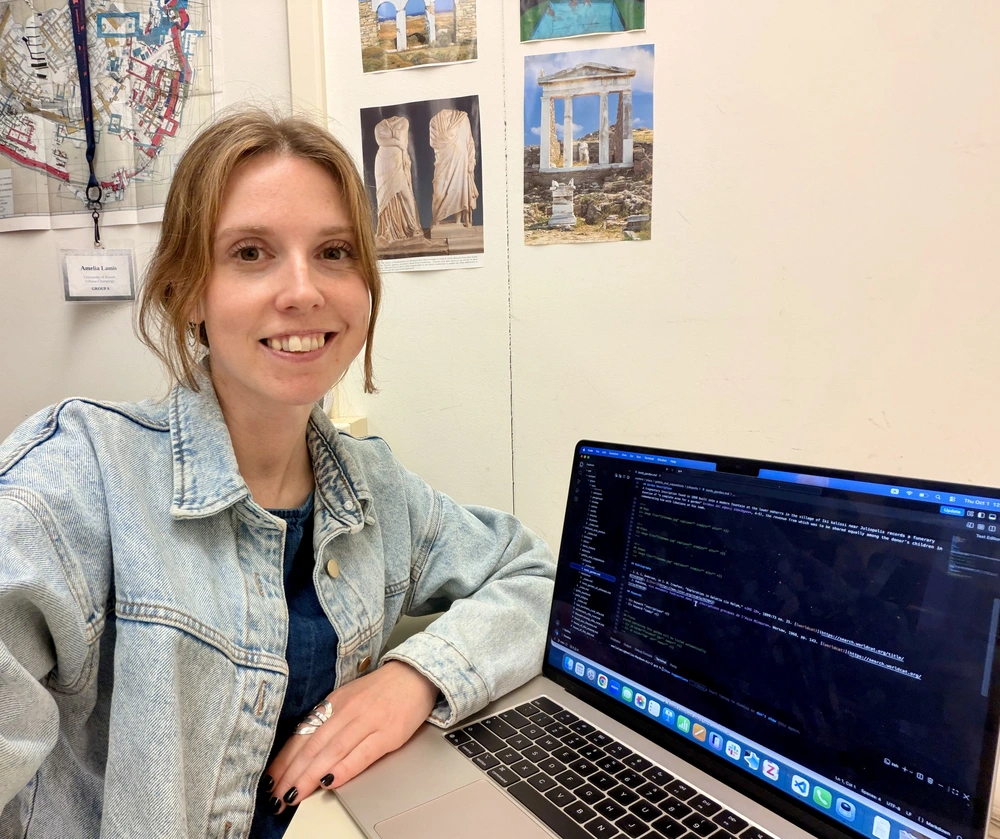
Over the summer, third-year graduate student Amelia Lamis completed a research internship with the Gardens of the Roman Empire Project, a digital humanities initiative that aims to bring knowledge of Roman garden archaeology out of local archaeological journals and print books into a free open access resource that provides scholars, students, and professionals global access to evidence of all types for ancient garden culture. Here, she tells us about her experiences.
Tell us about your summer work with the GRE project.
My main task this summer was updating the Gardens of the Roman empire website with the latest information our team has compiled about the many, many gardens which existed across the vast Roman empire. This includes info about where exactly these gardens were located, when they were occupied, their excavation history, descriptions of the site and region, and bibliography so our visitors can follow up on the latest scholarship and excavation reports for their research.
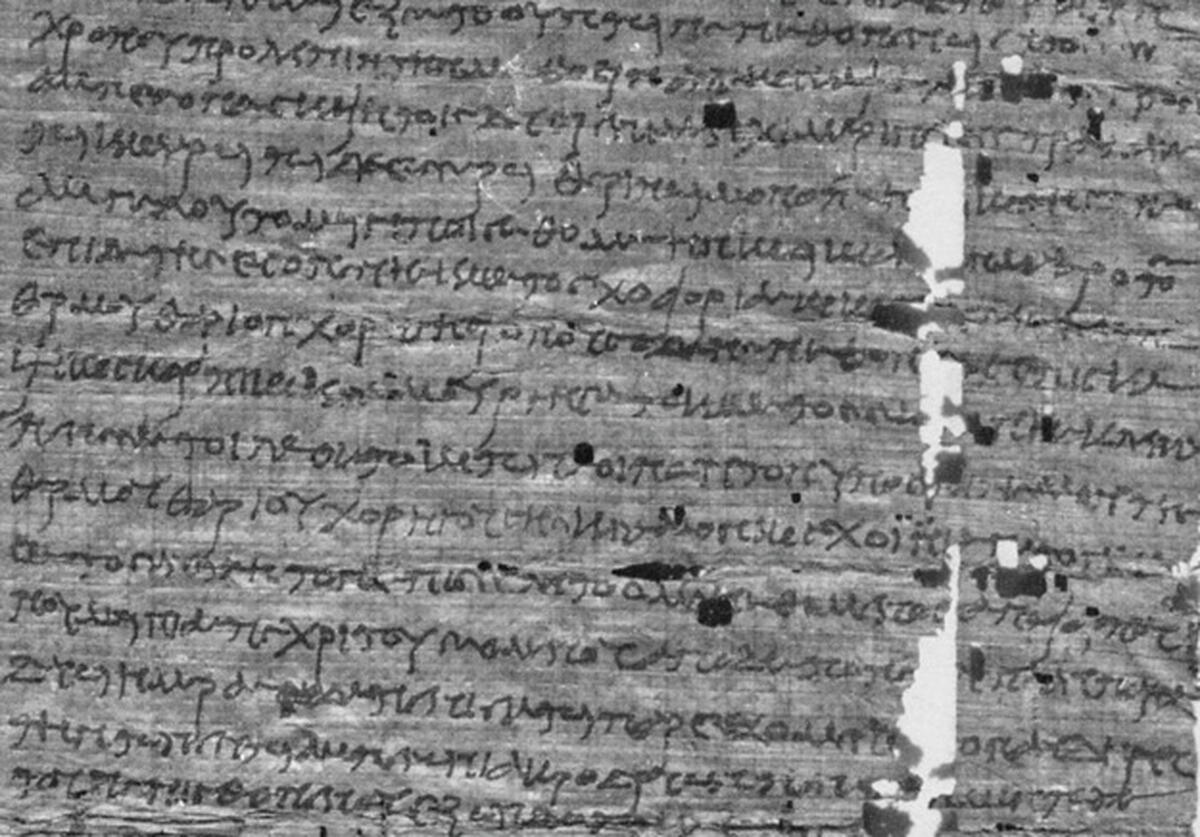
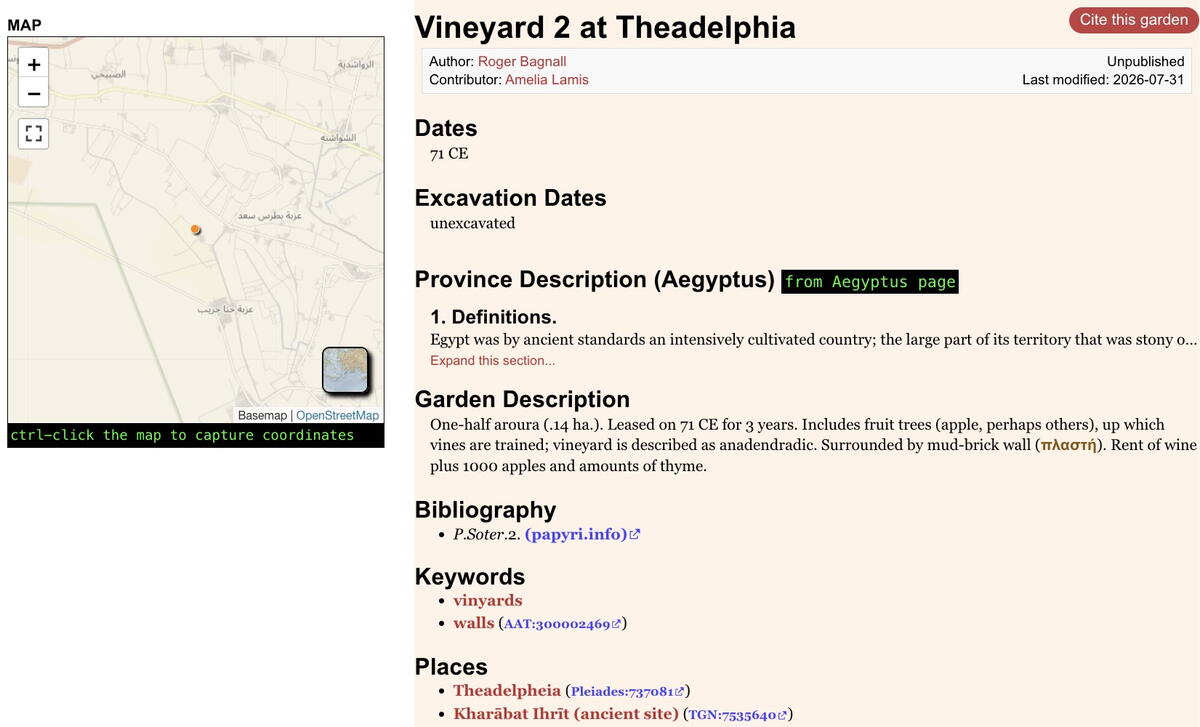
Since my training is specifically in translating and interpreting Latin and Greek literary sources, I was also tasked with tracking down papyri and inscriptions from the Roman imperial period which contain information about these gardens, and adding them to the garden descriptions with an English translation. Papyri and inscriptions offer fascinating details about ancient gardens and the people involved in their upkeep. For example, we know from a 2000-year-old papyrus written in Greek (P.Soter.2, Fig 1.) about a small vineyard in Theadelphia, Egypt, which was leased in 71 CE for three years by a man named Soterichos. According to the papyrus, the small property was surrounded by a mud brick wall, and contained apple and possibly other kinds of fruit trees. We even know the rent: wine, thyme, and 1000 apples!
As scholars of Latin and Greek literature, we spend a lot of our time working with texts from a few main epicenters of literary production, like Rome and Athens. But the Roman empire at its peak spanned three continents and nearly two million square miles, and GRE has catalogued gardens all across this massive expanse. Working on this project, I got to (virtually) travel around regions of the empire I was less familiar with, from the North African provinces of Libya, Numidia, and Egypt, to Asia Minor (Turkey) and Judaea, to Hispania and Gaul. This helped me experience the interconnectivity of the Mediterranean region during the imperial period, and notice the way design elements, like people, traveled across the empire.
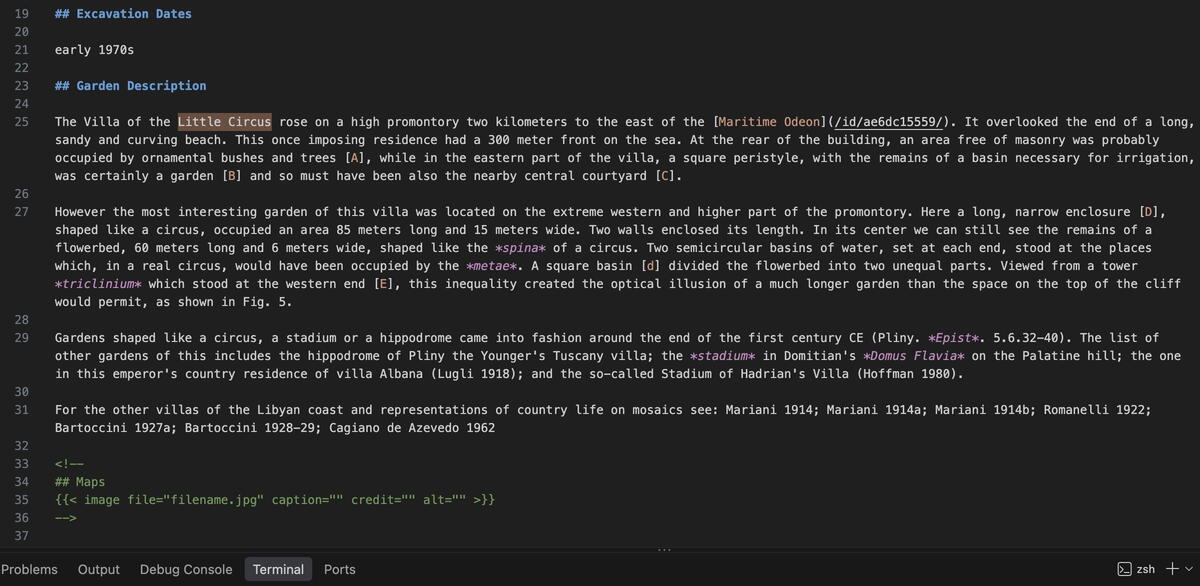
For example, in the 1970s archaeologists excavated a villa on the Northwestern coast of Libya, which was conquered and integrated into the Roman empire as a province during the imperial period. This imposing residence is known as the “Villa of the Little Circus” because its gardens were arranged, through planting and optical illusions, to look like a chariot-racing stadium or hippodrome. We hear from the Roman writer Pliny the Younger (Epist. 5.6.32-40) that gardens shaped like circuses came into fashion during the late first century CE; his villa had one, as did those of the emperor Domitian.
What new skills did you learn while working on this project? Did you encounter any challenges?
I came to GRE with limited experience using code editing software and GitHub, so when I first started working I would double and triple check every pull request to make sure I didn’t delete important data or spell peristyle wrong. But after a week or two, I got comfortable with the process, and discovered that working with code is (surprisingly) a lot of fun! In traditional academia, publishing an article can take years, and may only reach a small audience of specialists. Seeing my GRE contributions so quickly published and accessible to any interested person with internet access was a thrilling change of pace.
Working with GRE also reoriented my focus from my own ideas to the user experience. The aim of digital humanities projects like GRE -- to present interesting, accurate information in a clear, accessible way -- guides the choices we make behind the scenes, including how to structure information on a page, how much detail to provide, how much technical vocabulary to use, and so forth. To make these decisions, we need to imagine ourselves (as best we can) in the position of the various people who may visit our site. What information is the most relevant to them? Do the sources we link to require institutional access, or are they open access and easy to navigate? Should we include the ancient or modern name of a site, or both? Working at GRE, I learned that answering these questions well takes a lot of experience, continuous communication, as well as some trial and error. Rarely is there a right answer, but it is the task of those of us working on these projects to find the best answer for now, and remain flexible for when new information presents itself.
What was it like working with a multi-disciplinary team across several institutions?
Digital humanities projects are inherently collaborative. Accomplishing a project with as wide a scope as GRE requires years of dedicated work, consistent funding and trained contributors. To coordinate all the moving parts requires leaders with a clear vision and an ability to communicate that vision to contributors with diverse academic backgrounds and varied technical expertise. Fortunately, Divya Kumar-Dumas, the project’s Managing Editor and Digital Strategy Coordinator, and Keith Jenkins, the Technical Lead, are exactly such leaders. Collaborative and generous, Divya and Keith modeled the kind of leadership that facilitates an interdisciplinary project’s success and made working with GRE an enjoyable and meaningful experience. Our international summer team also included post-docs and early career scholars, as well as my fabulous advisor and expert on Roman gardens, Victoria Austen, who recruited me for the project.
As I mentioned, papyri and inscriptions are crucial sources for understanding Roman gardens. At GRE, I was fortunate to collaborate with scholar and papyrologist David Ratzan, Professor of Ancient Studies at NYC and Head of the ISAW Library. David’s expertise came in handy when, for example, we needed to alter our code to accommodate changes in one of the papyrological databases we had been linking to. David also generously allowed me to join his summer papyrology workshop where I was able to deepen my knowledge of the field’s history and methodologies, and practice reading and transcribing Greek papyri.
For GRE, collaboration extends to building mutually beneficial relationships with other digital humanities projects. One such project is Pleiades, a community-built gazetteer and graph of ancient places, spearheaded by Managing Editor Tom Elliott. Many of GRE’s garden pages include a link to a corresponding Pleiades page (Fig. 3), where visitors can find additional information about the location, topography, and naming history of an ancient site (ever wonder what the name of the island of Rhodes was in Ottoman Turkish?). An exciting part of the Pleiades project is that anyone can become a contributor after completing the training sessions. If you’re interested in geography and the ancient world, check it out!
Finally, how has working on the GRE Project changed or developed your view on the role of Digital Humanities within the field of Classics?
I’m very inspired by the increasing number of sophisticated digital humanities projects which share research and insights about the ancient world with a wider audience. There are a lot of people out there who are curious about what daily life was like 2000-years-ago, and gardens --which intersect the domestic, public, and funerary spheres -- offer a way to make the distant familiar. I loved learning about a veteran of the Roman army who dedicated a garden in Panoplis, in the Upper Nile region, and then worked the land with his sons; about a gardener who was hired by the king to plant new trees and nurse damaged ones back to health after his city was attacked by Philip V of Macedon; and let’s not forget about the tomb garden of Athenais, the daughter of Xennios, whose gravestone calls down “incurable disease on any who wish to harm” the deceased! Digital humanities projects make these stories accessible and bring a more diverse audience into conversations about what makes us human.

Amelia Lamis is a third-year graduate student at the University of Illinois. Her research focuses on narrative, performance, and identity. She also teaches undergraduate courses in Latin and Cultural Studies. During summer 2026, she helped publish over 100 new garden entries for the GRE project.