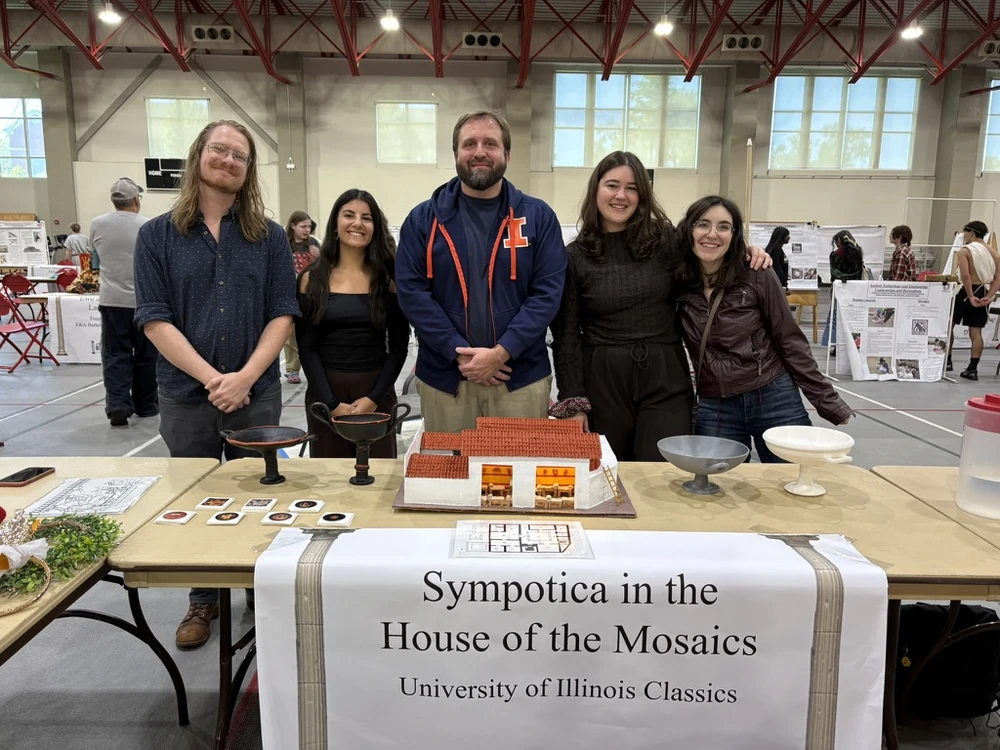
Monmouth Classics Day is a major outreach event designed to introduce the general public to numerous aspects of the ancient Mediterranean world and its connections to cultures and languages of the present day. Held once every two or three years on the campus of Monmouth College, Classics Day involves approximately 50 stations at which students, faculty, and community members share their knowledge of a particular topic with visitors from all over western and central Illinois. Attendees can learn how to chisel letters into marble, play Roman board games, throw a discus the ancient Greek way, and much, much more.
As one of the premier centers of Classical Studies in the state, the U of I Classics Department has proudly sent contingents of graduate students and faculty, both to present cutting edge research that would not otherwise be available at the event, and to celebrate the widespread fascination the ancient world continues to inspire. This year, graduate students Vaughn Fenton, Maria Moulita, and Margarita Pyrgali participated in the event, under the supervision of Associate Professor Dan Leon; they were also accompanied by alum Elisa Jennings. Here, Margarita and Maria discuss their use of replicas to introduce attendees to the culture of the Greek symposium.
Tell us about your station at the event and how you came up with the concept.
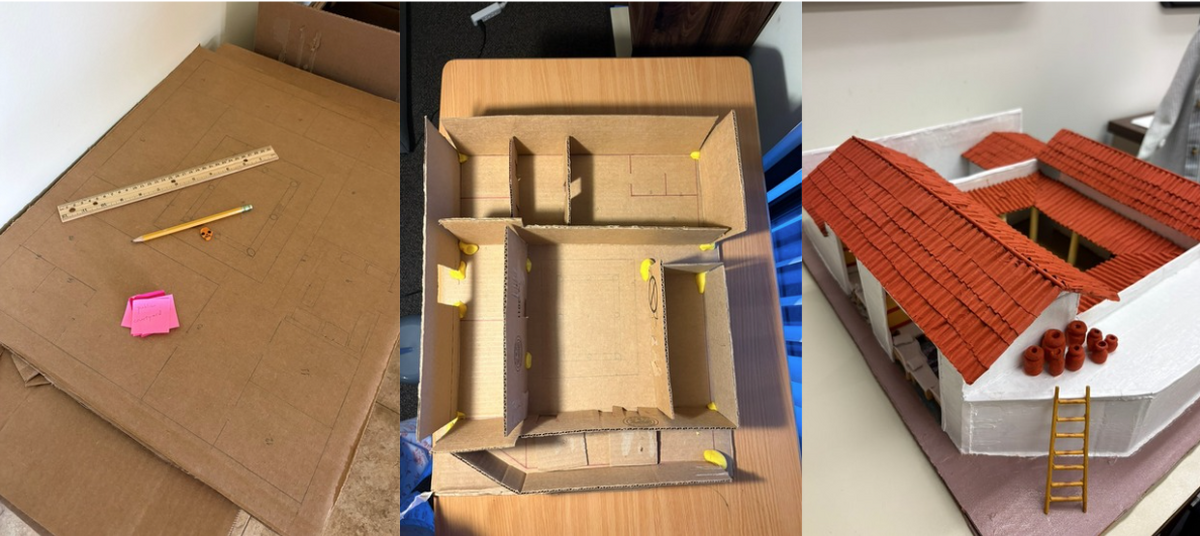
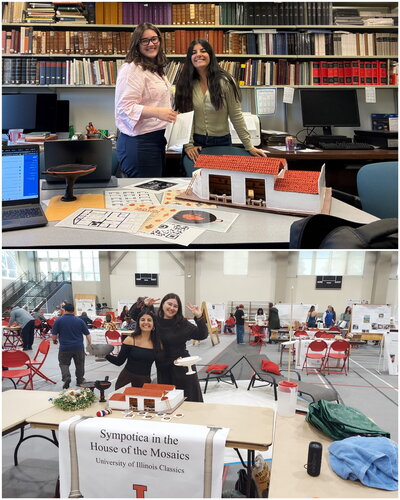
Margarita: We introduced our audience to the logistics of the archaic Greek symposium by guiding them through our replica of the House of the Mosaics in Eretria. Working on the ancient house model was a highlight for me, especially because it led me to think more deeply about the realities of ancient domestic space and gave me a new perspective on its organization.
Maria: The preparation for the event started about a month in advance. The inspiration came from an educational trip I took to the Greek island of Euboea (Evia), where we visited the museum. One of the things that caught my attention was a replica of the House of the Mosaics. So, when we heard about the Monmouth event, this professional replica immediately came to my mind. With cardboard as our main material, pictures from the museum, research articles, and an architectural plan of the structure, we started drawing our sketch! Creating the replica gave us the chance not only to introduce our audience to the architecture of a wealthy Classical house, but also to explore the function of these rooms, the paraphernalia, the lavish decoration, the participants, their entertainment, and the historical roots of the symposium. In other words, the materiality of this house was a great way to explore many aspects of Greek entertainment, daily life, and architecture.
In addition to the House of the Mosaics replica, you also re-created an ancient Greek game (kottabos) using replica drinking cups. Tell us about that process and participant reactions.
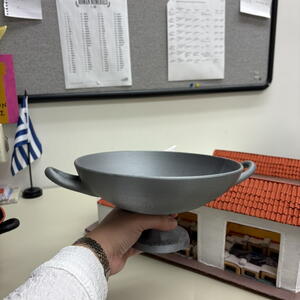
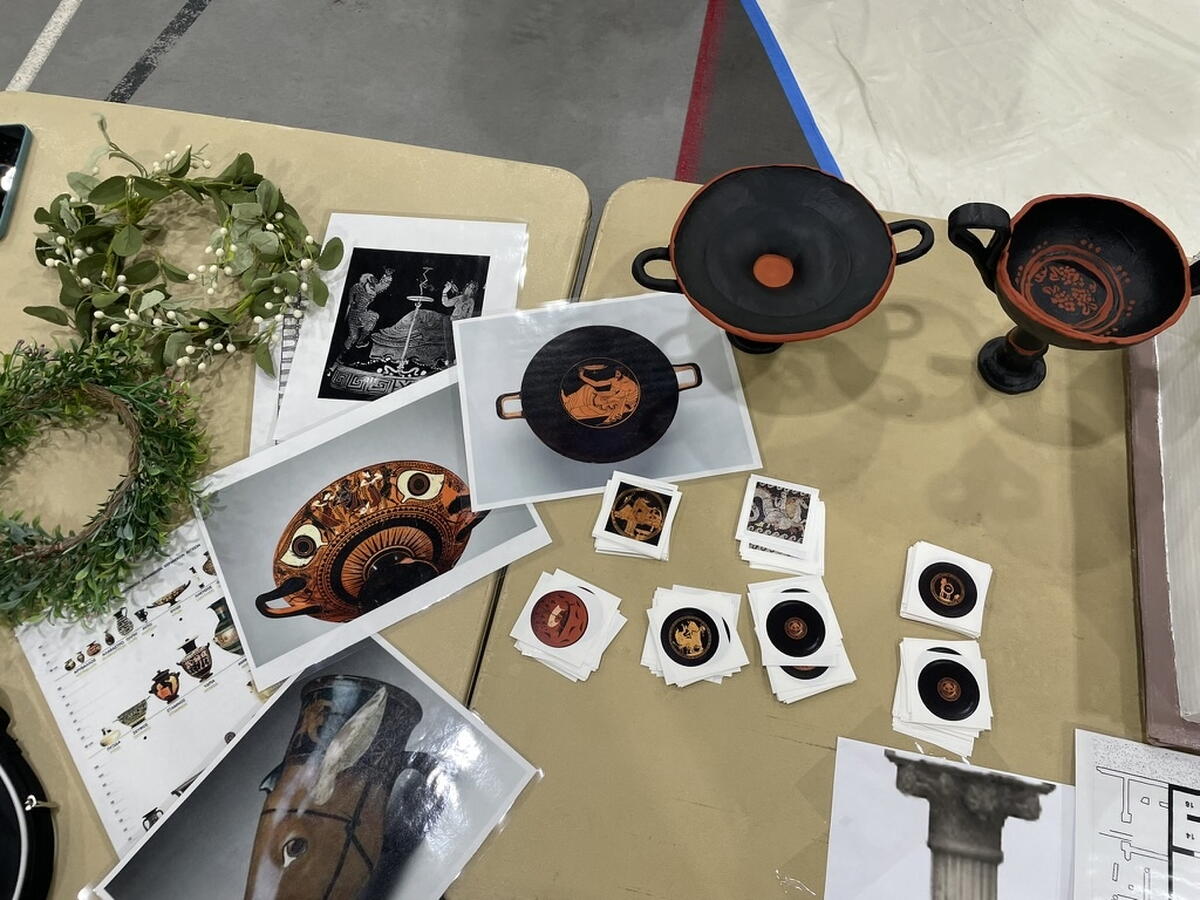
Maria: We had initially made our own pottery with air-dried clay to illustrate the ancient cups; however, we soon realized that in order to actually play kottabos we would need waterproof cups! So, we took advantage of equipment available to us through our department’s “Parthenon at Illinois” project, a digital humanities initiative that gave us access to a 3D printer. We printed two symposium kylikes; so people stopping by our table could play the game with water. I was especially excited to see people getting competitive and taking videos of their friends trying to knock the disc off the stick and trying again and again.
Margarita: For our audience, one of the main attractions was definitely the opportunity to engage directly with sympotic paraphernalia through our air-dry clay and 3D-printed kylix replicas, as well as to use them to play the game of kottabos. The game sparked conversations about the human dimension of the symposium, particularly the role of enslaved people in preparing the space and equipment and cleaning up afterward. It also encouraged participants to appreciate the remarkable skill and precision required to succeed at the game, particularly after one has been drinking so heavily!
What will you take away from your experience of Monmouth Classics Day?
Maria: Margarita and I were very enthusiastic from the very first day we decided to participate in the outreach event at Monmouth College! We really enjoyed both the process of making everything by hand and seeing people interact with our materials. Also, nothing would have been the same without having each other, as well as our super supportive and enthusiastic supervisor, Professor Dan Leon.
Margarita: Witnessing how vibrant the classics community remains was one of my favorite parts of Monmouth Classics Day. It was wonderful to see that people’s fascination with the ancient world and their curiosity about its practical realities remains very much alive!
Maria Moulita is a third-year PhD at the University of Illinois. She is interested in migration and diasporas in antiquity, representations of the East in Greek and Latin literature, and emotions in ancient Greek literature, especially in relation to migration and displacement.
Margarita Pyrgali is a third-year PhD student at the University of Illinois. Her research interests include Greek epigraphy and the materiality of ancient texts, and she advocates incorporating material culture into the teaching of classical languages.